Christmas Cookie Cutters: A Baker's Buying Guide
Affiliate disclosure: This article contains affiliate links. If you buy through them, we may earn a small commission at no extra cost to you. As an Amazon Associate I earn from qualifying purchases. Links go to Amazon search results for the product types we mention, not to specific products we have tested.
Cut-out cookies are one of the most fun parts of holiday baking, and the cutter you choose decides a lot about how they turn out. A good cutter gives clean edges, releases the dough easily and survives years of December baking. A poor one squashes the dough, leaves ragged edges, or rusts after one wash.
This guide covers how to choose the best cookie cutters for Christmas: materials, shapes, sizes and sets, and how to care for them. You'll also find tips for clean cut-out cookies, so your stars still look like stars after baking.
Cookie cutter materials compared
Stainless steel
Stainless steel cutters are the all-round choice for most home bakers. The edge is thin enough to cut cleanly through chilled dough, and stainless resists rust much better than plain tin. Look for a rolled or folded top edge so it's comfortable to press. Most are fine to wash by hand and dry straight away; check the maker's care advice before using a dishwasher.
Tinplate (tin-plated steel)
Many traditional and vintage cutters are tinplate. They cut very sharply and are often inexpensive, but they can rust if left wet. Wash by hand, dry immediately, and some bakers pop them in a still-warm oven for a few minutes to dry the seams fully.
Copper
Copper cutters are sturdy, look beautiful hanging on a tree or in a gift basket, and usually come in larger, simpler shapes. They tend to cost more and should be washed by hand.
Plastic
Plastic cutters have a blunter edge, which makes them a good choice for young children: they're safer to press and come in bright, easy-to-grip designs. The trade-off is less crisp edges, especially on intricate shapes.
3D-printed cutters
Custom 3D-printed cutters (often sold by small makers) offer shapes you won't find anywhere else, from family pets to house outlines. Printed plastic has tiny ridges between layers that can trap dough, and many common printing materials can warp with heat. Hand wash them in lukewarm water, never in the dishwasher, and dry them well.
Shapes that work (and shapes that break)
The shape matters as much as the material. When you choose Christmas cookie cutters, think about how the baked cookie will survive decorating, stacking and gifting.
Shapes that hold up well:
- Stars, especially with slightly rounded points
- Christmas trees with a wide trunk
- Mittens and stockings
- Round or fluted ornaments
- Gingerbread people with chunky arms and legs
- Snowflakes with thick arms
Shapes that break easily:
- Reindeer with thin antlers and legs
- Candy canes with a narrow hook
- Very detailed snowflakes with thin spokes
- Anything with long, narrow points
Thin parts bake faster than the rest of the cookie, so they brown or burn first and then snap off when you decorate. If you love a detailed shape, roll the dough slightly thicker and watch the bake closely.
For royal icing, simple silhouettes are easier. Big, flat areas are ideal for flooding with icing, and clear outlines are easier to pipe around.
Size and depth
- Around 3 inches (7.5 cm) is a comfortable size for most cut-out cookies: big enough to decorate, small enough to bake evenly.
- Mini cutters (1 to 1 1/2 inches) are great for linzer cookie windows, pie crust decorations and garnishing a yule log or cake.
- Large cutters (4 to 5 inches) make statement gingerbread people but need careful baking so the middle cooks before the edges brown.
- Depth: a cutter that is at least about 3/4 to 1 inch (2 to 2.5 cm) deep handles thick dough without pushing it out the top. Very shallow cutters are fine for thin dough only.
Try to bake same-size shapes on the same tray. Mixing tiny and large cookies on one sheet means the small ones overbake before the big ones are done.
Sets vs single cutters
Nested sets (several sizes of the same shape, like stars from small to large) are space-saving and let you make stacked star "trees." Themed sets give you a full Christmas lineup at once. Single cutters are worth buying when you want one excellent, sturdy version of a favorite shape.
If you're starting from scratch, a basic Christmas set with a star, tree, gingerbread person, snowflake, stocking and round ornament covers most needs. Add a nested round or fluted set and you can make linzer cookies, sandwich cookies and biscuit-style shapes too.
Plunger and stamp cutters
Plunger cutters have a spring-loaded stamp inside that pushes the dough out and often imprints a pattern. They're quick and fun, especially for kids, and the imprint gives decoration without icing. They work best with firm, chilled dough and simple recipes. Wash and dry them carefully, as dough can hide around the spring.
Cookie stamps press a design into a round of dough. They need a dough with little or no leavening, otherwise the pattern puffs away in the oven.
How to get clean cut-out cookies
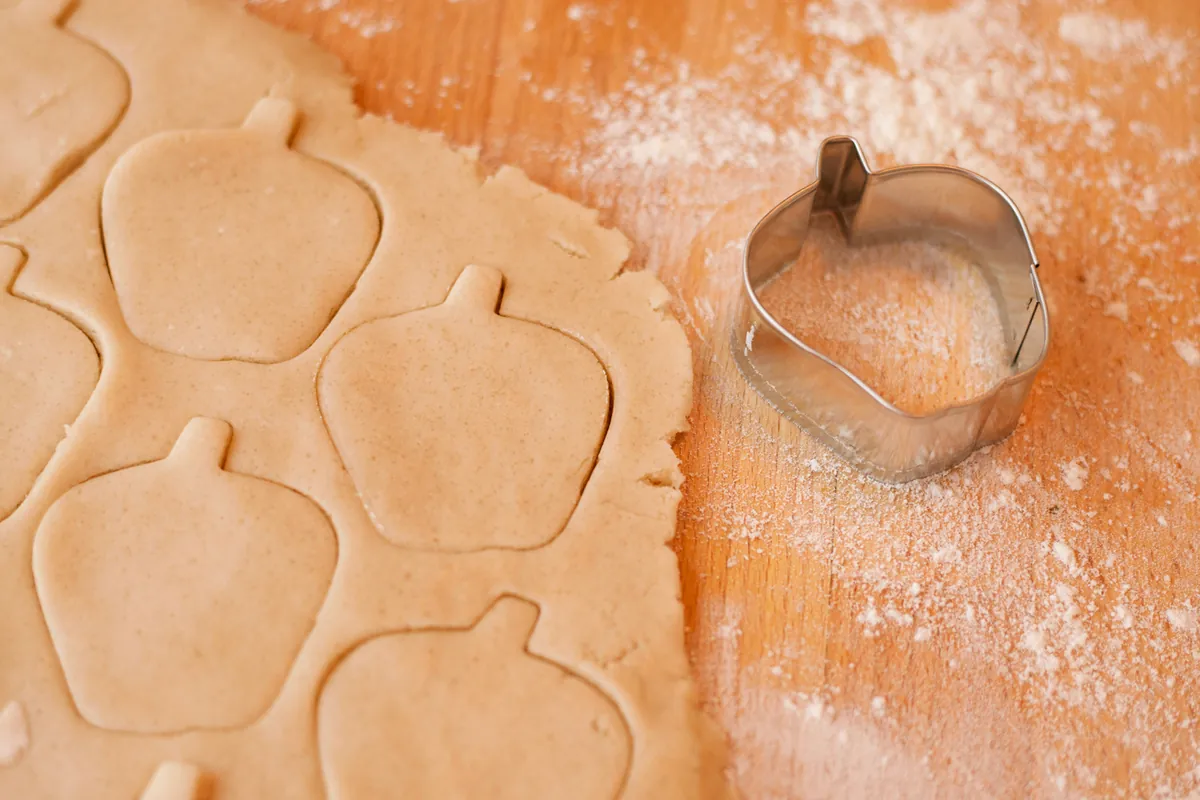
- Chill the dough before rolling. Warm dough sticks to the cutter and stretches.
- Roll between sheets of parchment to avoid adding too much flour.
- Roll to an even 1/4 inch (6 mm). Rolling guides or spacer rings on your rolling pin help.
- Dip the cutter in flour between cuts if the dough sticks.
- Press straight down and lift without twisting. Twisting distorts the shape.
- Cut shapes close together to reduce re-rolling. Re-rolled scraps get tougher each time.
- Chill the cut shapes on the tray for 10 to 15 minutes before baking. This is the single best trick to prevent spreading.
A dough that holds its shape
Even the best cutter can't save a dough that spreads. For a reliable, no-fuss dough to use with your cutters, follow our Christmas cut-out sugar cookies recipe: chill the rolled sheets, cut cold, and bake on a cool tray for the sharpest edges.
Cutters worth a look (with verified details)
These are specific cutters and sets whose details we checked on the maker's or retailer's product page. They aren't ranked; each suits a different job. Check current listings before buying, since sets and availability change.
Wilton Christmas Cookie Cutter Set, 18 pieces (model 2308-5454)
A large, classic holiday assortment. The Amazon listing describes 18 tinplate steel cutters in shapes including a tree, mitten, stocking, reindeer, angel, snowflake, snowman, candy cane, star and Santa hat, each about 3 inches high, packed in a reusable plastic storage container. The care instructions say to hand wash in warm, soapy water, rinse and dry thoroughly.
Suits: families who want lots of shapes in one box. Keep in mind: it's tinplate, so dry it straight away to prevent rust, and the reindeer and candy cane have the thin parts discussed above.
Shop the Wilton 18-piece Christmas cutter set on Amazon
Ann Clark cookie cutters
Ann Clark says its cutters are hand-made from American tin-plated steel at its facility in Rutland, Vermont, that it has about 800 shapes in circulation, and that the cutters have 1-inch-deep construction. That depth comfortably handles ¼-inch dough.
Suits: bakers who want US-made metal cutters or a specific single shape. Keep in mind: as with any tin-plated cutter, hand wash and dry promptly.
Shop Ann Clark Christmas cookie cutters on Amazon
Ateco 5-piece plain star cutter set (7805)
A graduated set of stars. Ateco lists the cutters as ranging from 1.75 to 3.5 inches, 1.125 inches high, made of stainless steel (made in China). Graduated stars let you bake stacked star "trees" as well as single cookies.
Suits: stacked star trees, and anyone who wants stainless steel for easier care. Keep in mind: it's one shape in several sizes, not a themed set.
Shop the Ateco 7805 star cutter set on Amazon
Ateco Linzer tart cookie cutter set (4844)
For jam-filled sandwich cookies. Ateco says the set makes 2-inch linzer cookies and includes six interchangeable center designs, instructions and a recipe; it's stainless steel, made in China. Ateco also lists a larger linzer set (4841).
Suits: linzer cookies for gift tins and cookie exchanges. Keep in mind: the small center pieces are easy to lose, so store them together.
Shop the Ateco 4844 linzer cutter set on Amazon
The Fussy Pup copper Christmas cutters
For gifting or an heirloom shape. The Fussy Pup describes its cutters as handcrafted, solid copper and made in the USA by a family-owned business, and its Christmas collection includes shapes such as a gingerbread man (about 6 x 4.25 inches), a sleigh (about 4.5 x 3 inches) and a Santa hat (about 5 x 3.5 inches). They're sold on the maker's own site: The Fussy Pup Christmas cookie cutters (a plain link; we don't earn from it).
Suits: gifts, larger statement cookies and decorating a gift basket. Keep in mind: copper cutters should be hand washed, and larger shapes need careful baking so the center cooks before the edges brown.
Caring for your cookie cutters
- Wash in warm soapy water soon after use so dough doesn't harden in the seams.
- Dry immediately and thoroughly, especially tinplate.
- Store flat in a box or tin so shapes don't bend. Stacking heavy items on top can warp thin metal.
- Straighten a slightly bent metal cutter gently with your fingers before using it again.
Matching cutters to your recipe
Different doughs suit different cutters:
- Decorated sugar cookies: simple, flat silhouettes with sharp metal edges. Our Christmas cut-out sugar cookies use no leavening, so outlines stay crisp.
- Gingerbread people: chunky shapes with thick limbs; try our soft gingerbread cookies, or the firm dough in our gingerbread house recipe for ornaments.
- Shortbread: simple rounds, fluted circles or stars; a dense dough like our classic buttery shortbread cuts cleanly with any metal cutter.
- Pie crust decorations: mini leaves, stars and snowflakes from our all-butter pie crust.
For icing ideas once your cookies are cut and baked, see our easy Christmas cookie decorating ideas.
What to look for when buying Christmas cookie cutters
Here's a quick checklist, followed by search terms to compare options:
- Material that suits you: stainless steel for everyday use, plastic for little hands, copper for gifting.
- A comfortable top edge: rolled or covered so it doesn't dig into your palm.
- Enough depth for 1/4-inch dough.
- Sturdy shapes with thick limbs and rounded points.
- Care instructions you're happy to follow, especially if you rely on a dishwasher.
Search terms:
- Christmas cookie cutter sets: christmas cookie cutter set stainless steel
- Nested star cutters: nested star cookie cutter set
- Plunger cutters for kids: christmas plunger cookie cutters
- Copper cutters for gifting: copper christmas cookie cutter
- Rolling pin spacer rings or guides: rolling pin with thickness rings
- Half-sheet baking pans: aluminum half sheet baking pan
Frequently asked questions
Are metal or plastic cookie cutters better?
Metal cutters, especially stainless steel, usually give cleaner, sharper edges. Plastic cutters are blunter, which makes them safer and easier for children to use.
Why do my cut-out cookies lose their shape?
Warm dough and too much air in the butter are the usual causes. Chill the rolled dough, chill the cut shapes again before baking, and don't overbeat the butter and sugar.
Can cookie cutters go in the dishwasher?
It depends on the material. Tinplate can rust and 3D-printed plastic can warp, so hand wash those. Check the maker's instructions for stainless steel and plastic.
How thick should I roll cut-out cookies?
About 1/4 inch (6 mm) is the standard for cookies that are sturdy enough to decorate and still tender. Thinner dough bakes crisper and is more fragile.
What size cookie cutter is best?
Around 3 inches is a good everyday size for decorated cookies. Use minis for linzer windows and pie decorations, and large cutters for statement gingerbread people.
How do I stop dough sticking to the cutter?
Use well-chilled dough and dip the cutter in flour between cuts. Press straight down and lift without twisting.
Read next: 25 Christmas Cookie Recipes for a Cookie Exchange (Sturdy, Scalable and Box-Ready) →